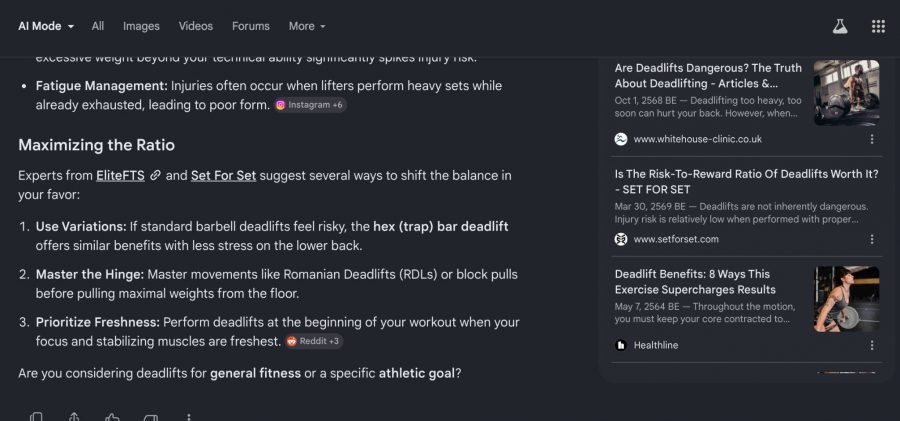
The rise of AI, specifically LLMs (Language Learning Models) like ChatGPT and GROK, is revolutionizing how we get our information. People are using it to do everything from coding to writing shopping lists; literally anything to make life more convenient.
Naturally, people have begun to look at ChatGPT for nutrition and training advice, but the question remains: Does ChatGPT make a good trainer? A new study suggests so; however, we believe it’s more nuanced and actually points to a larger issue.
Key Points You Need To Know!
A study showed that ChatGPT provides better answers to fitness questions compared to fitness trainers
However, it misrepresents the ability of AI Chatbots, or more importantly, fails to show their limitations
ChatGPT can’t be smarter than qualified trainers, as it forms its answers from them
ChatGPT and other AI Chatbots can be useful tools to improve fitness, but their limitations must be understood
What Is AI And ChatGPT?
First, we need to understand what “AI” is, specifically ChatGPT. Being branded as “AI”, many people incorrectly assume ChatGPT is an all-powerful source of information that analyzes everything to construct the best answer.
It’s not. In fact, ChatGPT never constructs its own, unique opinion.
At its core, ChatGPT is a sophisticated chatbot. Specifically, it’s a Large Language Model, or LLM.
What Are Large Language Models (LLMs)?
An LLM (Large Language Model) is a type of artificial intelligence trained on massive amounts of text to understand and generate human-like language.
Here’s how it works:
It takes in text (your prompt)
Breaks it into smaller pieces called tokens (words or parts of words)
Predicts the most likely next token based on patterns it learned during training
Repeats this process rapidly to generate full sentences and responses
At its simplest, it attempts to predict how people speak.
While it’s obviously more sophisticated than making a guess, an LLM isn’t even retrieving answers from a database. Rather, it’s;
Reconstructing responses based on learned language patterns
Weighing probabilities of different word sequences
Generating outputs that statistically “fit” the input
Furthermore, they are not intelligent. They possess:
No understanding
No awareness
No intent or reasoning in a human sense
No grounding in reality (only patterns in text)
Why Is This Important?
Many people have been falsely led to believe CGPT is a genius. It’s not.
There are numerous instances where it gives false information, among other issues, sometimes leading to legal action and even the hospital!
And because it’s built to provide answers, it tends to want to please the user rather than stand on solid opinions.
ChatGPT answers very differently depending on who asks it.
A user can sway their answers without knowing it.
You realize you can’t necessarily trust it.
Can ChatGPT Be A Good Trainer?
So, since we know a bit more about how ChatGPT works, can it be a good trainer? Some say yes, and some say no.
A new study put this to the test and put ChatGPT against 9 Level-4 trainers from various countries to test their knowledge (D’hoe et al., 2026). The questions were open-ended and required written answers from the PTs and ChatGPT, which were graded by experts.
It was found that ChatGPT provided better answers to 6 of the 9 questions. Here’s a summary of the question and results:
Questions in which ChatGPT scored higher
How often do I need to train for the training to be effective?
How do I lose abdominal fat?
How can I maintain my motivation to work out?
How can I train around pain?
Working out at what time of the day leads to the most effective results?
Which exercises are best for losing weight?
Questions in which ChatGPT tended to score higher
How do I get a tighter stomach?
Questions in which PTs and ChatGPT gave similar answers
How do I train to lose weight?
Is cardio better for losing weight than strength workouts?
Sounds impressive, and some have made claims that “ChatGPT is better than trainers!”
But what’s the reality?
Is ChatGPT Really Smarter Than Personal Trainers?
While it does show that ChatGPT can answer fitness questions, we’re not sure this “proves” ChatGPT is smarter than trainers. Before jumping to conclusions, consider these points:
The questions were objective and aligned with the guidelines.
The fitness industry is full of opinions with varying levels of legitimacy. Some of these are based on experience, some on research, and some on YouTube videos.
At the same time, the answers are based on accepted guidelines. This makes sense, but how often have we seen general consensus change?
Low-volume vs. high-volume for hypertrophy
Machines vs free weights for muscle growth or strength?
Steady-state vs HIIT
Is body recomposition possible?
If you were to ask Dorian Yates, Louie Simmons, Mark Rippetoe, or the late (and great) Charles Poliquin these questions, you’d likely get different answers. That’s because they all have their own way of doing things.
It doesn’t necessarily mean they’re wrong; it just means they’re answering from a personal viewpoint.
ChatGPT is programmed to provide comprehensive answers on mainstream narratives.
ChatGPT’s entire architecture is built to provide thorough, comprehensive answers based on mainstream beliefs.
In other words, it basically parrots leading viewpoints and opinions.
There’s absolutely nothing wrong with this, but ChatGPT providing answers that would satisfy top experts is what it’s literally trained to do.
Remember, it’s not creating its own ideas but repeating what experts have said online.
Heck, even SET FOR SET is referenced on various AI ChatBots!
The main issue is that AI Chatbots take information from qualified trainers and experts to repackage and present as an answer; it does do this well, but recalling information is not the only job of a trainer.
PTs aren’t writers or content creators.
In contrast, most PTs aren’t trained writers, educators, or content creators. They’re not trained in delivering simple, concise answers.
Believe us, this takes specialized skill.
At the same time, they weren’t told the study’s purpose. Would this have changed anything?
Perhaps, if they knew their answers were being compared to ChatGPT. Many of the PTs seemed to answer what they would do rather than provide a broad answer.
For example, one PT said they prefer intermittent fasting for weight loss. Not necessarily wrong, but it’s not “the best way” to lose fat.
The questions were very basic and non-comprehensive.
The questions asked were terribly basic and far from comprehensive in terms of fitness. We listed all 9 above, but a summary includes;
5 questions on fat loss
2 questions on the best way to train
1 question about motivation
1 question training around pain
There were 0 questions on building muscle, increasing strength, or cardio. The only questions that addressed these were very general in nature.
What This Study Really Tells Us.
When we look at the answers, we see nothing groundbreaking. In fact, 3 of the answers look pretty much identical; a bullet list of basic training advice.
Healthy Diet
Strength Training
Cardiovascular Exercise
Consistency
Hydration
Sleep
Stress Management
But here’s what’s important. All of this information already exists online; that’s how ChatGPT found it in the first place. For example, here are some questions with answers from SET FOR SET articles.
“How often do I need to train for the training to be effective?”
Is Low-Volume Training Effective for Muscle Growth and Strength? | Science Explained
“How do I lose abdominal fat?”//”How do I get a tighter stomach?”
The Science-Backed Best Exercises To Lose Belly Fat?
The Best Ab Workout (Based on Science)
“How do I train to lose weight?”
5 Parts Of An Effective Weight Loss Program
“Which exercises are best for losing weight?”
Cardio Or Strength Training: What’s Better For Weight Loss?
Best Exercises To Lose Weight?
Working out at what time of the day leads to the most effective results?
Working Out in the Morning vs Night, Which is Best?
So when it comes to answering basic training questions, ChatGPT can definitely do that, but the answers are no different from those if you consulted with a qualified company!
Is ChatGPT Smarter Than ChatGPT As A Trainer?
So here’s the fun part. To drive our point home, we reran the questions through ChatGPT with no context.
We first challenged it on the idea of spot reduction. In the study, when asked how to lose belly fat, ChatGPT added, “Remember that spot reduction (targeting fat loss in a specific area) is not possible,“ without being prompted.
A side note, you typically see new trainers add extra information unprompted as a way to show their education. Interesting……
Regardless, after providing several studies that show it might be possible under the right circumstances, CGPT replied:
We then plugged all of CGPT’s answers into CGPT. We told it that it was a trainer’s answer and if it could grade and comment on it.
It could. It actually gave us 10 points; here are a few:
It’s too generic (biggest issue)
Poor prioritization (everything looks equal)
Cardio explanation is shallow
“Best exercises for weight loss“ is framed wrong
Strength training explanation is slightly off
Now, there’s nuance to this, but the main point is that CGPT will correct its own answers. Even if you suggested “it’s because you asked it to critique”, that still raises the issue that it doesn’t stand on solid ground; it simply provides answers based on speech patterns.
Was it originally wrong? Or is it wrong now?
Should You Use CGPT As A Personal Trainer?
Now we don’t think CGPT is horrible, and there are some people for whom it makes sense to use it. Therefore, here are some requirements for anyone wanting AI to write them a workout program;
1. You should understand the basic functions of AI, how it works, and its limitations. Understand it’s not perfect, so don’t assume everything it says is right.
2. You should have a basic understanding of fitness and what you need. As it generally provides positive answers, asking it a question can throw it off, as CGPT tends to want to please the user.
3. Someone who wants help to mix things up or get feedback.
With that said, there are also other issues you need to be aware of.
For example, we had it admit it’s wrong on various issues and flip its opinion.
For example, we had asked about the 5 events of the Army Fitness Test (AFT) and the 7 events of the new Combat Fitness Test (CFT). It repeatedly told us we were wrong until we had it recheck the data:
And look at what happened when we told ChatGPT we were going to see Ozzy (RIP) play…
…and after we told it to check the latest data.
We have more examples of errors ChatGPT and AI Chatbots make, so go check out this article if you’re interested!
Final Takeaway: What Does All This Mean?
While ChatGPT can be a useful tool, it can never be better than a qualified personal trainer, as it relies on information from qualified trainers and experts to craft its answers! This is in addition to ChatGPT not being able to give nuanced advice, and it obviously can’t give in-depth feedback.
With that said, it can be an alternative tool for their fitness journey if they understand CGPT’s limitations.
FAQ: Is ChatGPT Good For Fitness Training?
1. Is ChatGPT actually better than a personal trainer?
No. ChatGPT can answer basic fitness questions well, but it is not better than a qualified personal trainer. It provides generalized, guideline-based advice, while real coaches offer personalized programming, real-time feedback, and adjustments based on your progress, goals, and limitations.
2. What are the biggest limitations of using ChatGPT as a personal trainer?
ChatGPT has several key limitations:
It gives generic, non-individualized advice
It can produce incorrect or fabricated information
It cannot assess form, fatigue, or injury risk
It often provides agreeable answers instead of critical feedback
These issues make it unreliable for advanced or highly specific training needs.
3. Can ChatGPT create an effective workout or fat loss plan?
ChatGPT can help create a basic workout or fat loss plan based on general principles like calorie balance, progressive overload, and consistency. However, these plans often lack personalization and may not account for your experience level, recovery, injuries, or specific goals.
4. Is ChatGPT reliable for fitness and nutrition advice?
ChatGPT can be useful for general fitness and nutrition information, but it is not fully reliable. It may use outdated data, repeat common misconceptions, or generate confident but incorrect answers. Important information should always be fact-checked with credible sources or professionals.
5. Who should use ChatGPT for fitness advice?
ChatGPT is best suited for:
Individuals with basic fitness knowledge
Coaches or experienced lifters looking to increase productivity
People seeking ideas, structure, or general guidance
It is not ideal for beginners who cannot verify information or anyone needing personalized coaching, injury management, or precise programming.
References
Ahmad, Z., Kaiser, W., & Rahim, S. (2023). Hallucinations in ChatGPT: An unreliable tool for learning. Rupkatha Journal on Interdisciplinary Studies in Humanities, 15(4), 12. https://www.researchgate.net/publication/376844047
Chelli, M., Descamps, J., Lavoué, V., Trojani, C., Azar, M., Deckert, M., Raynier, J. L., Clowez, G., Boileau, P., & Ruetsch-Chelli, C. (2024). Hallucination rates and reference accuracy of ChatGPT and Bard for systematic reviews: Comparative analysis. Journal of Medical Internet Research, 26, e53164. https://www.jmir.org/2024/1/e53164
D’hoe, B., Kirk, D., Boone, J., & Colosio, A. (2026). ChatGPT outperforms personal trainers in answering common exercise training questions. Journal of Sports Science and Medicine, 25(1), 235–261. https://doi.org/10.52082/jssm.2026.235
Eichenberger, A., Thielke, S., & Van Buskirk, A. (2025). A case of bromism influenced by use of artificial intelligence. Annals of Internal Medicine Clinical Cases, 4, e241260. https://doi.org/10.7326/aimcc.2024.1260
Emsley, R. (2023). ChatGPT: These are not hallucinations—they’re fabrications and falsifications. Schizophrenia, 9, 52. https://doi.org/10.1038/s41537-023-00379-4
