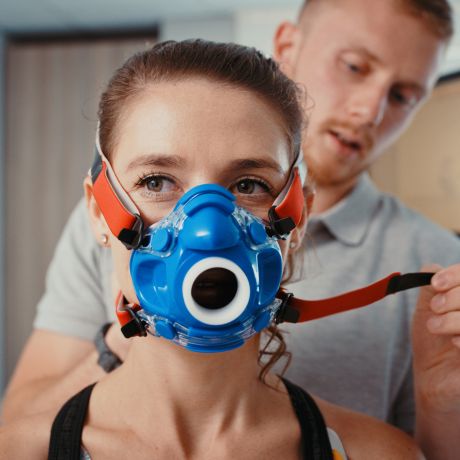
VO2max is the new fitness variable everyone is talking about. It’s the number one indicator for cardiovascular fitness, and we now know there’s a strong correlation with mortality.
This is 100% true, which has resulted in many fitness influencers using this to sell programs and various fitness tech. While VO2max is important, do we need to focus on it, and should we be measuring and tracking it?
This article will look at this nuanced subject and determine if you need to worry about VO2max or just focus on training and progressing.
Key Points You Need To Know!
VO2max measures how well your body can process and utilize oxygen
It’s the primary measurement for cardiovascular fitness and is correlated with decreased mortality.
The fitness and longevity movement falsely equates VO2max as the driver of health
The training that increases VO2max is the real driver of longevity
Increasing VO2max doesn’t make you healthy; it indicates you are healthy
What Is VO2max?
VO2max is the maximum volume (V) of oxygen (O2) your body can consume, transport, and use per minute during intense or maximal exercise.
In other words, how well your body uses oxygen.
Improving your VO2max essentially improves your entire cardiovascular system. For this reason, it’s considered the Gold Standard for measuring aerobic fitness and cardiorespiratory endurance (Mandsager et al., 2018).
Physiological Adaptations To Increasing VO2max
Improving your VO2max requires adaptations to multiple systems.
Stroke Volume: Aerobic training enlarges the left ventricle, allowing it to pump more blood per beat.
Capillary Density: Your body grows new microscopic blood vessels around skeletal muscles, shortening the distance oxygen has to travel to reach muscle tissue.
Blood Volume: Total blood volume and red blood cell count increase, expanding the oxygen-carrying capacity of your circulatory system.
Mitochondrial Density: Endurance training multiplies the number and size of mitochondria, the cellular power plants that convert oxygen into usable energy (ATP).
Enzyme Activity: Aerobic enzymes become more active, accelerating the breakdown of carbohydrates and fats.
Myoglobin Levels: Muscle cells produce more myoglobin, a protein that traps oxygen entering the cell and delivers it directly to the mitochondria.
Ventilatory Threshold: Training delays the point at which your breathing becomes rapid and labored, allowing you to sustain higher intensities with less effort.
Diaphragmatic Strength: Targeted breathing exercises strengthen respiratory muscles, reducing the energy cost of breathing itself.
As such, even though VO2max is a single number, it actually tells a much larger story.
VO2max And Longevity
Over the past few years, the relationship between increased VO2max and longevity has become a popular topic of discussion.
Improving fitness decreases mortality; who would have thought?
But seriously…it makes sense. VO2max is an indicator of your cardiovascular health and body composition.
When we break down the relationship between decreased mortality and mortality risk, it looks something like this:
Sedentary: Baseline (Highest risk)
Below Average / Active: 50% drop in risk
Above Average: 60% to 70% drop in risk
High: 75% to 80% drop in risk
Elite: 80% drop in risk
We see that by far, the biggest jump occurs from a sedentary lifestyle to meeting basic physical activity levels (Mandsager et al., 2018). This minimal improvement decreases odds by 50%!
From there, jumping to a higher bracket brings a much smaller increase in benefits.
Now, you may notice we don’t have specific numbers, and that’s because we think this part is a bit overblown for most people.
Is VO2max Important For Health?
Let’s be clear: increasing VO2max is crucial for determining a person’s cardiovascular fitness and overall health. We’ve also shown it to be a clear health marker for longevity.
But people are missing the point. VO2max is just a measurement of the work you’ve done.
A higher VO2max doesn’t make you healthy; it means you are healthy.
The Hype Of VO2max Health Metrics
Health metrics can be useful in some capacity, but the fitness industry has turned measuring them into an entire industry.
When it comes to certain metrics like V02max for longevity, the focus is placed on the end result rather than the process.
We compare this to your GPA. Compare these two sentences;
Studying consistently will likely get you into a good college.
Getting a high GPA will likely get you into a good college.
One focuses on the behavior (studying), while the other focuses on the outcome (GPA).
But they’re essentially saying the same thing in a different way.
When relating this to VO2max and longevity;
Exercise is the “studying” or behavior.
VO2max is the “GPA” or outcome.
Longevity is “getting into a good college.”
What’s really decreasing mortality risk are the adaptations caused by exercise, and your VO2max is a metric for measuring them.
Increased Physical Activity, Mortality, and Longevity
Here’s the thing: we’ve known about the relationship between physical activity and mortality for years (Ammous et al., 2025)! Saying “increase your VO2max” is simply another way of saying that!
So it’s really not saying anything new; it’s just using a specific metric to measure.
A new 12-year study was just published, further proving this. It found that moderate and vigorous physical activity are associated with slower epigenetic aging (Liu et al., 2025).
This is one of numerous studies that show this relationship.
The point is, however you want to call it, increasing your physical activity and improving body composition is the real medicine that’s improving health and longevity.
So, Is VO2max Hype?
The relationship between VO2max and longevity isn’t necessarily hype; there’s a clear, obvious link.
However, the way it’s being presented in some circles is definitely overkill and a bit misleading.
It’s not a new discovery, nor is there a specific training plan to increase VO2max, at least going from lower levels to higher. Essentially just a new way to say what we know: improving physical activity is associated with decreased mortality.
So it becomes a problem when certain companies begin selling tech to measure your VO2max or treat it as a unique, specialized training variable.
VO2max is important, but as long as the average person is improving body composition, increasing activity levels, and training harder, there’s really no reason you need to test it.
If you need help with a proper training program, we have a library to choose from. Or contact us about a personalized program or training.
FAQ: Longevity And VO2Max: Hype Or Real?
What Is VO2max?
VO2max is the maximum amount of oxygen your body can use during exercise. It is considered the gold standard measurement for cardiovascular fitness and aerobic endurance.
Why Is VO2max Important For Longevity?
VO2max is important because higher levels are strongly associated with better cardiovascular health, improved fitness, and lower mortality risk. In general, people with higher VO2max levels tend to live longer and healthier lives.
Does Increasing VO2max Actually Help You Live Longer?
Research consistently shows that improving cardiovascular fitness and VO2max is associated with reduced mortality risk. However, the exercise and physical activity used to increase VO2max are likely the true drivers of improved longevity.
Do You Need To Measure Or Track VO2max To Improve Health?
No. Most people can improve their health and cardiovascular fitness simply by exercising consistently, increasing physical activity, and improving body composition without directly measuring VO2max.
What Is The Fastest And Easiest Way To Improve VO2max?
For most people, the easiest way to improve VO2max is through consistent cardiovascular exercise such as walking, jogging, cycling, rowing, or interval training. Beginners can see significant improvements simply by becoming more active.
Is VO2max A Cause Of Better Health Or Just A Measurement Of Fitness?
VO2max is primarily a measurement of cardiovascular fitness rather than the direct cause of better health. A higher VO2max generally indicates that a person has developed positive adaptations from regular exercise and physical activity.
References
Ammous, F., Peterson, M. D., Mitchell, C., & Faul, J. D. (2025). Physical Activity Is Associated With Decreased Epigenetic Aging: Findings From the Health and Retirement Study. Journal of cachexia, sarcopenia and muscle, 16(3), e13873. https://doi.org/10.1002/jcsm.13873
Crimmins, E. M., & Beltrán-Sánchez, H. (2011). Mortality and morbidity trends: is there compression of morbidity?. The journals of gerontology. Series B, Psychological sciences and social sciences, 66(1), 75–86. https://doi.org/10.1093/geronb/gbq088
Freeman K. S. (2011). U.S. lives: longer but sicker?. Environmental health perspectives, 119(3), a118. https://doi.org/10.1289/ehp.119-a118a
Garmany, A., Yamada, S., & Terzic, A. (2021). Longevity leap: mind the healthspan gap. NPJ Regenerative medicine, 6(1), 57. https://doi.org/10.1038/s41536-021-00169-5
Liu, T., Conley, Y. P., Erickson, K. I., Miao, H., Connolly, C. G., Ormsbee, M. J., & Li, C. (2025). 12-year physical activity trajectories and epigenetic age acceleration among middle-aged and older adults. Biological Research for Nursing, 27(3), 442–452. https://doi.org/10.1177/10998004251334415
Mandsager, K., Harb, S., Cremer, P., Phelan, D., Nissen, S. E., & Jaber, W. (2018). Association of cardiorespiratory fitness with long-term mortality among adults undergoing exercise treadmill testing. JAMA Network Open, 1(6), e183605. https://doi.org/10.1001/jamanetworkopen.2018.3605
Olshansky S. J. (2018). From Lifespan to Healthspan. JAMA, 320(13), 1323–1324. https://doi.org/10.1001/jama.2018.12621
Yang Y., Dixon-Suen S. C., Dugué P. A., Hodge A. M., Lynch B. M., English D. R. (2022). Physical activity and sedentary behaviour over adulthood in relation to all-cause and cause-specific mortality: A systematic review of analytic strategies and study findings. International Journal of Epidemiology, 51(2), 641–667. https://doi.org/10.1093/ije/dyab181
You Y., Chen Y., Wang X., Wei M., Zhang Q., Cao Q. (2023). Accelerometer-measured physical activity patterns are associated with phenotypic age: Isotemporal substitution effects. Heliyon, 9(9), Article e19158. https://doi.org/10.1016/j.heliyon.2023.e19158
