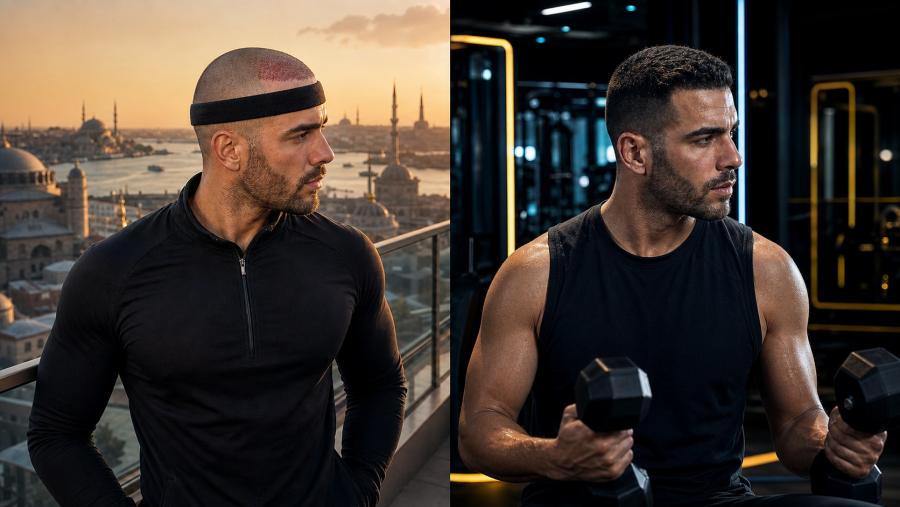
Turkey is estimated to perform around 1 to 1.5 million hair transplant procedures per year, representing roughly 25 to 35 percent of global hair-restoration surgeries, according to international hair-restoration practice censuses and Turkish health and tourism data.
That scale has made Istanbul in particular a hub for the procedure, drawing patients from across Europe, North America, and the Middle East for a combination of experienced clinics, modern technique availability, and a cost that is typically lower than equivalent care at home.
If you train seriously, though, booking a hair transplant in Turkey raises a question that has nothing to do with price or hairlines: how much is this going to cost you in the gym, and how does travel change that?
It’s worth working through before you book anything. A hair transplant in Turkey usually means a trip of three days to a week. Most clinics build in an initial post-op check before you fly home, followed by weeks of recovery, managed remotely once you’re back.
Knowing what that recovery looks like and how it interacts with travel and your training schedule makes the decision easier to plan for. If you’re someone who already tracks recovery closely, this is a good moment to lean on the same instincts as our guide to using biofeedback to know when to scale training back. The same principle applies here, just with a surgical recovery layered on top.
Why the gym is off-limits immediately after a hair transplant in Turkey
The core risk isn’t the workout itself. It’s what intense exercise does to blood flow and scalp movement in the first days after grafts are placed. Elevated heart rate and blood pressure increase blood flow to the scalp, which can raise the risk of bleeding or swelling around the transplant site in the earliest days.
Sweat increases the risk of infection around healing incisions, and friction from hats, headbands, or brushing against gym equipment can dislodge grafts before they’ve anchored. This reflects general post-operative guidance used by clinics such as Cosmedica, an Istanbul-based hair transplant clinic associated with Dr. Levent Acar, though individual instructions may vary depending on the technique and healing progress.
Does the technique change the timeline?
Not significantly. Whether the procedure uses Sapphire FUE or Micro Sapphire DHI, the grafts still need the same anchoring window before they can tolerate sweat, pressure, or elevated blood flow.
Technique affects things like scarring pattern and session length, not how quickly you can safely return to training. Looking at hair transplant before and after results from either technique gives a realistic sense of what full healing eventually looks like, even though the early gym restrictions are the same regardless of method.
The realistic recovery timeline after a hair transplant in Turkey
Phase
Timeframe
Gym status
Notes
Phase 1
Days 0 to 3
No gym
Short, flat walks only. Grafts are most vulnerable in this window.
Phase 2
Days 4 to 9
Still no gym
Light walking only. This typically overlaps with travel home for international patients.
Phase 3
Days 10 to 14
Light bodyweight work
Bodyweight squats, lunges, light push-ups. RPE 5 to 6 out of 10, 30 to 45 minutes, 3 to 4 times weekly. No heavy compound lifts or HIIT.
Phase 4
Weeks 3 to 4
Gradual reintroduction
Light machine-based work is often better tolerated than free weights at this stage. See our breakdown of machines vs. free weights for this kind of lower-intensity phase. Load typically progresses gradually back toward normal training over roughly two weeks, though this varies by patient and should follow your surgeon’s specific guidance.
Phase 5
Weeks 4 to 6+
Full access
Scalp should be fully healed. Scabbing from FUE or DHI procedures should have resolved.
This timeline reflects general post-operative guidance used by clinics including Cosmedica, though healing rates vary and specific instructions from your surgeon should always take precedence.
Common questions from lifters considering a hair transplant in Turkey
Can I still take my usual supplements during recovery?
Most standard supplements are unaffected, but stimulant-heavy pre-workouts that spike blood pressure are worth avoiding in the first two weeks. If you’re unsure where your protein intake sits during a lower-training-volume phase, see our full breakdown of how much protein is actually too much.
Will I lose muscle during the layoff?
A two-to-four-week reduction in training intensity is unlikely to cause meaningful muscle loss for most trained lifters, though perceived strength may dip temporarily.
Can I train legs while I wait to train upper body or vice versa?
No. The concern is systemic (heart rate, blood pressure, sweat), not localized to the area worked, so all resistance training is restricted during the earliest phases, regardless of muscle group.
Does the recovery timeline affect the cost of treatment?
Not directly, but it’s worth factoring into your planning. Turkey hair transplant cost typically includes accommodation and aftercare support for the initial recovery days, which is part of why clinics build a short in-country stay into most packages.
The bottom line
A hair transplant in Turkey is a manageable interruption to training, not a long-term derailment, provided the early weeks are respected. For lifters, the real planning work is less about hairlines and more about building the travel and recovery timeline into a training calendar in advance.
